Build vs Buy for AI: What SMBs Should Actually Own
A practical framework for deciding when AI tools are commodities to buy versus strategic to build, based on data, not vendor demos.
The real cost of building an AI tool internally is not the first version.
It is the maintenance, the edge cases you did not foresee, the model updates that break your pipeline, and the 3 weeks your best engineer spends debugging a hallucination problem instead of shipping features that actually differentiate your business.
The build vs buy conversation around AI has grown louder as tooling explodes. What is often missing is a clear framework for the decision. Not a checklist, but a way of thinking about what is commodity and what is core.
The Real Decision
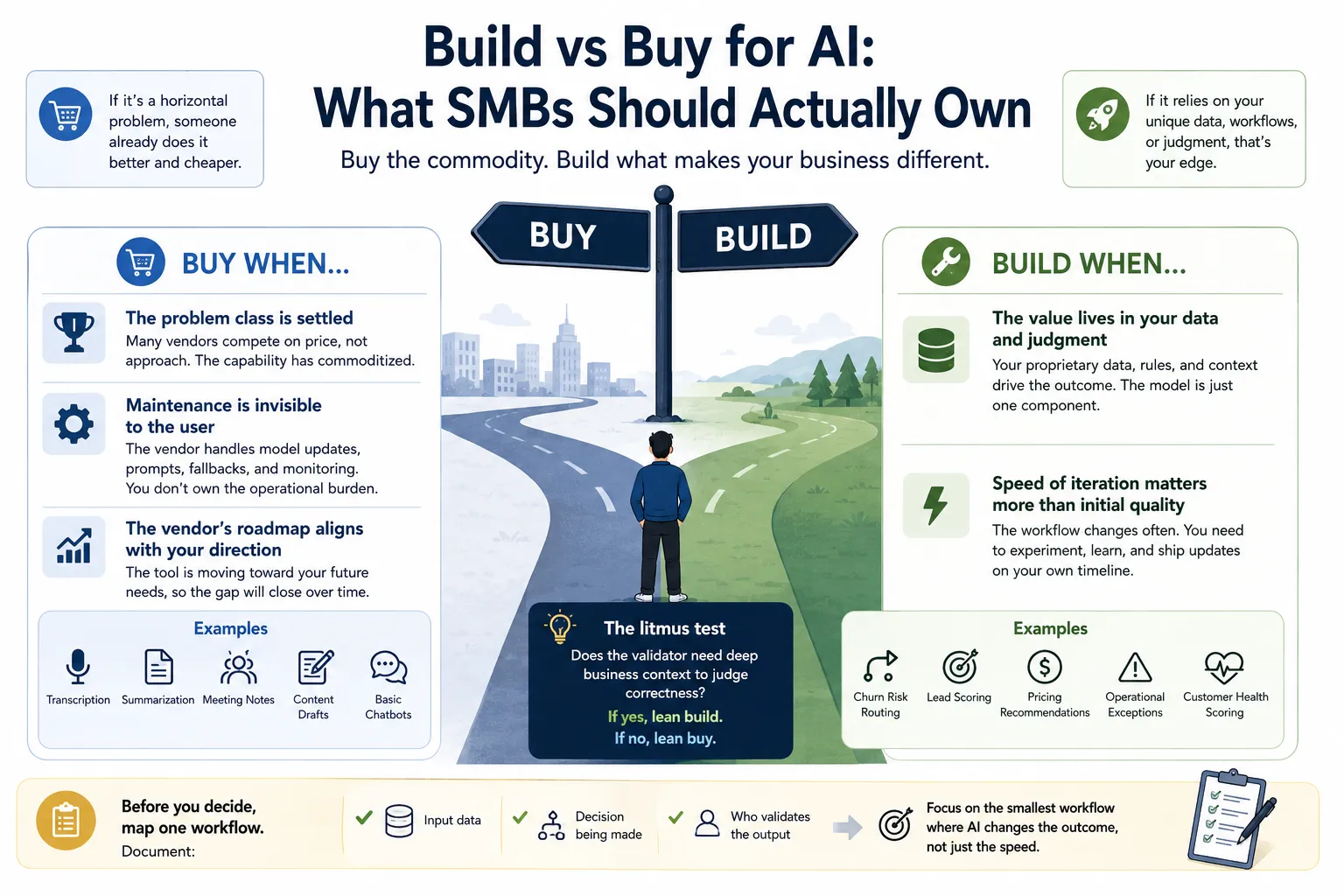
Buy anything that solves a horizontal problem. Build only what encodes proprietary data, workflows, or judgment that competitors cannot replicate.
Horizontal problems are becoming table stakes: summarization, transcription, basic content generation, meeting notes, and standard chatbots.
The market is racing to offer these cheaper, faster, and more reliably than any internal team can maintain. Your competitive edge does not come from running a better RAG pipeline than the next company.
Strategic AI lives where your unique operating data intersects with a decision only your team knows how to make.
If the logic sits in a spreadsheet that only your ops lead understands, or a routing decision reflects five years of industry intuition, that is the seam worth building on.
When Buying Makes Sense
Some AI capabilities are important, but not worth owning.
That distinction matters. A tool can be valuable without being strategic. You may rely on it every day, but still be better off buying it from a vendor.
There are three signals that an AI capability is probably a buy.
The problem class is settled
Multiple vendors compete on price rather than approach.
When tools for the same task, such as transcribing calls, differentiate on UI and integrations rather than core accuracy, the underlying capability has commoditized.
That does not mean the tool is unimportant. It means you do not need to own it.
You should not spend engineering time rebuilding a capability where the market is already producing better results at lower cost.
Maintenance is invisible to the user
The best SaaS AI tools handle prompt updates, model swaps, and fallback logic without you noticing.
This matters more than most teams realize.
A simple AI feature usually needs:
- Prompt versioning
- Output validation
- Error handling
- Cost monitoring
- Latency monitoring
- Human review flows
- Retry logic
- Model upgrade testing
- Protection against malformed inputs
- A way to inspect failures
If you buy the right tool, much of that operational burden disappears into the vendor’s product.
If you build it, you own all of that.
Forever.
The vendor’s roadmap aligns with your direction
You do not need a perfect match.
You need a tool moving in the same direction as your usage, so the gap closes over time rather than widens.
For example, if you need meeting summaries today and the vendor is clearly expanding into CRM notes, follow-up tasks, and sales call intelligence, that may be good enough.
But if you need workflow-specific decisioning and the vendor is focused on generic productivity features, the gap will probably grow.
A good buy decision is not just about the current feature set. It is about whether the product is likely to become more useful to you without requiring heavy customization.
When Building Makes Sense
Building should be the exception.
Not because internal teams cannot build good AI tools. They can. But every internal tool creates an ownership obligation.
You are not just building the first version. You are agreeing to maintain the system when models change, inputs get messy, users find edge cases, costs spike, and quality drifts.
That obligation is only worth it when the capability is tied to something proprietary.
There are two signals that an AI capability may be worth building.
The value lives in your data structure, not the model
A pricing engine that works because it understands your customer segments, margin thresholds, inventory constraints, and historical win-loss patterns is strategic.
The model is a component. The data model is the asset.
The same applies to workflows like:
- Prioritizing support tickets based on churn risk
- Scoring inbound leads using internal sales history
- Routing operational exceptions based on supplier behavior
- Recommending next actions based on proprietary customer lifecycle data
- Detecting anomalies using business-specific thresholds
In these cases, the AI is not valuable because it can generate text. It is valuable because it helps apply business judgment at scale.
That judgment is yours.
Speed of iteration matters more than initial quality
Sometimes the first version does not need to be perfect. It needs to change quickly.
If the workflow changes weekly based on new learnings, waiting for a vendor’s release cycle is painful. Internal tools you can reshape over a weekend win here.
This is common when you are still discovering the process.
Maybe your sales team is still learning which signals predict a good account. Maybe your ops team is still refining how exceptions are handled. Maybe your customer success team is still defining what “at risk” actually means.
In those cases, building internally can make sense because the tool is part of the learning loop.
You are not just automating a stable process. You are discovering the process itself.
A Concrete Example
Imagine an SMB with a customer support team handling hundreds of tickets per week.
A simple AI tool that summarizes tickets is probably a buy. Many products already do this well. The input is generic, the output is generic, and the business logic is limited.
But now imagine a different workflow.
Every incoming support ticket needs to be routed based on:
- Customer segment
- Contract value
- Renewal date
- Open opportunities in the CRM
- Product usage over the last 30 days
- Previous support history
- Sentiment in the ticket
- Whether the issue matches a known churn pattern
The output is not just a summary. The output is a decision:
- Route to standard support
- Escalate to customer success
- Alert the account owner
- Trigger a retention workflow
- Add to a product feedback queue
That starts to look strategic.
The AI is not just making the team faster. It is changing the outcome by applying business-specific judgment to each ticket.
A lightweight internal version might look like this:
- A new support ticket arrives in Zendesk or Intercom.
- A workflow pulls customer data from the CRM and usage data from the product database.
- A small service or automation formats the relevant context.
- The AI model classifies the ticket and suggests a route.
- The output is returned as structured JSON with fields like priority, routing_decision, reason, confidence, and recommended_next_action.
- Low-confidence cases go to a human for review.
- Reviewed decisions are stored so the system can be improved over time.
The first version does not require a complex architecture.
It could be:
- Zendesk or Intercom as the ticket source
- HubSpot, Salesforce, or Pipedrive as the CRM
- A product database or analytics tool for usage signals
- Zapier, n8n, or a small backend service to orchestrate the workflow
- An AI API for classification and reasoning
- A database table or spreadsheet to log outputs and human corrections
The important part is not the model. The important part is the business context around the model.
If the routing decision depends on your internal customer data, your renewal motion, your product usage patterns, and your team’s judgment, that may be worth building.
If it only summarizes the ticket, buy it.
The Traps That Cost Teams Time
The most expensive AI decisions usually come from misunderstanding what you are really committing to.
Do not build because “it is just an API call”
The demo takes a day.
The production system takes much longer.
A real system needs monitoring, guardrails, cost controls, fallback behavior, permission handling, logging, evaluation, and a plan for malformed inputs.
You also need to answer questions like:
- What happens when the model returns invalid JSON?
- What happens when the model is confident but wrong?
- Who reviews low-confidence outputs?
- How do you detect quality drift?
- How do you test a new model version before switching?
- How do you prevent sensitive data from going where it should not?
- How do you know whether the system is actually saving time?
These are solvable problems. But they are still problems.
If the workflow is not strategic, you probably do not want to own them.
Do not buy because a vendor demo looked magical
Demos are trained on happy paths.
Request a trial with your own data.
Give the vendor messy inputs, incomplete records, edge cases, and examples that look like your real work. If the vendor hesitates, that is information.
You are not buying the demo. You are buying the system that has to survive your actual workflow.
Avoid the expensive middle ground
The most expensive outcome is buying a tool you then heavily customize and maintain.
You get the licensing cost plus the engineering burden, with none of the flexibility.
This happens when a team buys a vendor tool, then builds custom scripts, workarounds, prompt layers, manual QA processes, and internal dashboards around it just to make it fit.
At that point, you are no longer buying a product. You are maintaining a product on top of a product.
That may still be the right decision in some cases, but do not drift into it accidentally.
A Simple Classification Exercise
Before evaluating any vendor or sprint-planning any build, document one thing:
The smallest workflow where AI changes the outcome, not just the speed.
Speed improvements are usually buys.
For example:
“It drafts emails faster.”
That is useful, but probably not strategic.
Outcome changes are potential builds.
For example:
“It routes support tickets differently based on churn risk signals from our CRM.”
That may be strategic because the decision depends on your business context.
Write down three things:
- The input data
- The decision being made
- Who validates the output
Then ask a simple question:
Does the validator need to deeply understand our business to judge whether the output is correct?
If yes, you may have found something strategic.
If any competent operator could validate it, you have probably found a commodity.
Take three or four workflows from your business and classify them.
For each one, write:
- What is the input?
- What is the output?
- What decision is being made?
- What data does the system need?
- Who reviews the result?
- Would a generic vendor solve 80% of this?
- Does this encode proprietary judgment?
You will usually find three categories.
Clear buys
These are horizontal workflows where vendors already compete aggressively.
Examples:
- Meeting notes
- Transcription
- Generic document summaries
- Basic chatbot support
- First-pass content drafts
- Simple email drafting
Buy these unless there is a strong reason not to.
Clear builds
These are workflows where your internal data and judgment drive the value.
Examples:
- Lead scoring based on historical close patterns
- Ticket routing based on churn risk
- Pricing recommendations based on margin and demand signals
- Operational exception handling based on supplier history
- Customer health scoring based on product usage and renewal context
Build these if the business value justifies the maintenance.
Unclear cases
These are the dangerous ones.
They look generic at first, but become specific once you inspect them.
For example, “customer support automation” sounds like a buy. But “support escalation based on contract value, renewal date, product usage, and executive sponsor involvement” may be a build.
The distinction matters.
Do not decide at the category level. Decide at the workflow level.
Need Help Making the Call?
If you are an SMB founder or operator and you are unsure which AI capabilities to buy, which to build, and which to ignore, the next step is not another vendor demo.
It is to map your workflows, identify where AI can change outcomes, and decide what is actually worth owning.
That is the kind of work I help with through my AI consulting services: finding the right AI opportunities, separating commodity use cases from strategic ones, and helping your team move from experiments to working systems.
The Real Question
The build vs buy decision is not really about AI.
It is about ownership.
What do you want your business to own?
You probably do not want to own transcription infrastructure, meeting summaries, or generic content generation. Those are useful, but they are not your edge.
You may want to own the systems that encode how your company makes decisions.
That is where AI becomes strategic.
Not because the model is rare. The model is increasingly available to everyone.
The strategy lives in the data, the workflow, the feedback loop, and the judgment around it.
Buy the commodity.
Build the parts that make your business different.